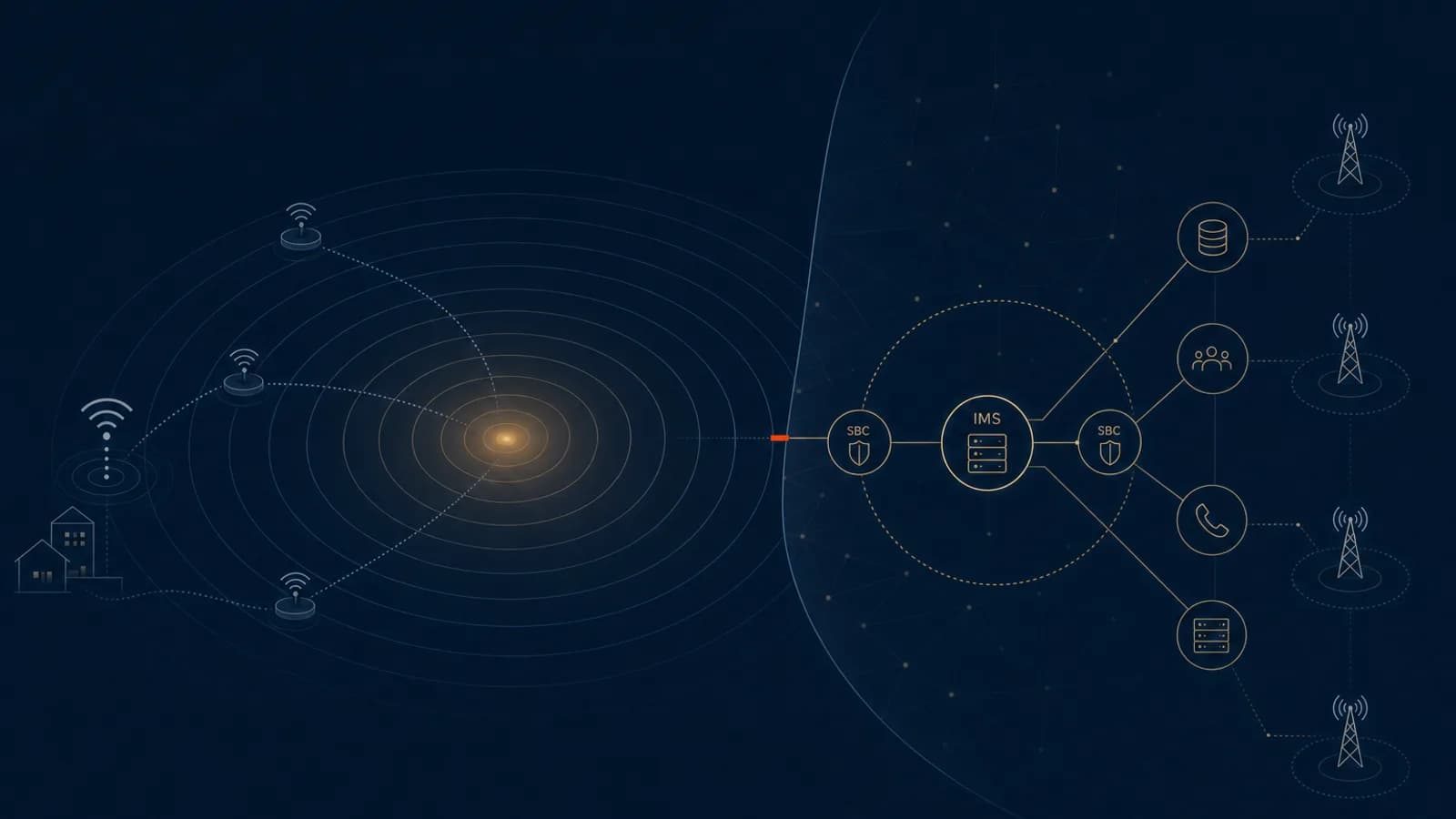
In a Tier-2 MNO, Southern Europe, ~18M subscribers, a digital MVNO launch team believed VoWiFi had cleared its final technical gate until test calls began dropping at the Wi-Fi-to-LTE boundary. The radio path worked, IMS registration looked clean, and the host’s ePDG capacity was not constrained. The unresolved issue was IMS interworking: which domain owned SBC policy, access-transfer behaviour, and the resulting customer-service liability.
The launch-room fault line was ownership, not Wi-Fi coverage
The launch team had treated VoWiFi as an access feature. Its retail scope assumed that an active call could move between trusted Wi-Fi and LTE without interruption, subject to normal coverage conditions. The host’s wholesale commitment was narrower. It covered registration through the ePDG and outbound calling within the host’s existing IMS policy envelope. It did not explicitly commit to access transfer for an MVNO-specific service profile.
That distinction survived component testing because each component behaved as specified. The handset established an IKEv2 security association, completed authentication, obtained IMS reachability, and originated a call. None of those results established what should happen when the access leg changed. Basic VoWiFi availability and session continuity were being measured as though they were the same wholesale deliverable.
The failure path crossed several policy points. P-CSCF selection determined where the session entered IMS. SBC routing rules determined whether the host preserved, re-anchored, or rejected the changing access leg. Media anchoring affected whether the bearer survived the transition. SIP session timers influenced whether the call remained viable while the handset re-registered. QoS treatment after LTE re-entry then determined whether a technically retained session remained usable.
The commercial question sat beneath those controls: would the host permit the MVNO-specific policy required for access transfer, and if so, which party would own its change control? The answer could not be inferred from a successful registration test. It required an explicit decision on policy authority across the access, border, and service-control layers.
Handset results made the boundary less visible rather than more. One device cohort completed the transfer, another re-originated the call, and a third dropped it. Firmware revisions, carrier bundles, IMS configuration, and OEM interpretation of operator profiles all affected the outcome. A network policy gap therefore appeared in the defect log as selective handset incompatibility. That diagnosis was convenient, but incomplete: the devices were exposing an undefined inter-domain behaviour.
“The Wi-Fi icon was never the commercial problem; the handover ownership was,” a Tier-2 head of wholesale recently observed.
SBC policy determines launch scope and the wholesale cost base
Once host and MVNO IMS domains are separated, the SBC becomes the practical control point for continuity commitments. Three operating models are viable. The MVNO can consume the host IMS and accept its feature envelope. It can introduce distinct IMS policy while retaining host access. Or the parties can establish explicit interworking across separate SBC and IMS domains. Each model is technically workable, but each produces a different product scope, cost base, and fault boundary.
The host-controlled model is usually the simplest to operate. It can also constrain supplementary services, caller identity presentation, emergency-call treatment, and alignment with RCS. Handset approval follows the host’s certification cadence because the MVNO cannot independently alter the operative IMS profile. That may be acceptable where the retail proposition mirrors the host offer. It becomes restrictive when the MVNO has committed to differentiated service behaviour or a broader device population.
Distinct MVNO policy creates more control, but not for free. The incremental cost extends beyond the per-subscriber wholesale rate. It can include SBC sessions and feature licensing, ePDG integration, AAA changes, Diameter routing, and PCRF/PCF alignment. Device certification cycles, interconnect test resources, and additional L2/L3 fault isolation also enter the operating model.
Separate IMS domains increase those costs because continuity must be designed as an interworking service rather than inherited as an internal host function. Both sides need compatible routing logic, media treatment, timer values, release causes, and trace access. They also need a controlled process for changes that may alter handset behaviour. An SBC software upgrade or revised carrier profile can affect access transfer even when the radio and ePDG layers remain unchanged.
Assurance and settlement exposure follow the same boundary. If a call falls back, re-originates, or drops during transition, CDR correlation and SIP traces must show which domain changed the session state. The parties must distinguish an access event in the host RAN or CN from an IMS provider decision or an MVNO service-layer response. Without that evidence, customer care assigns liability from symptoms, wholesale operations dispute the ticket, and recurring incidents remain open across billing periods.
The margin effect is easy to underestimate. A low-frequency continuity defect can generate repeated support contacts, replacement-device activity, and retention credits. The host may see no network outage, while the MVNO sees a failure against its retail promise. Both positions can be technically defensible. The cost persists because the wholesale construct did not identify who was being paid to assure the boundary.
Contractual service definition must precede operational acceptance
A credible launch gate starts with a contractual definition of successful handover. “VoWiFi supported” is insufficient. The service schedule should state whether an established session must survive Wi-Fi-to-LTE and LTE-to-Wi-Fi transitions, whether re-originated calls count as success, and which interruption threshold constitutes a failure. The measurement point also matters: handset perception, SBC signalling, media continuity, and billing continuity can produce different answers for the same event.
The supported handset and operating-system cohorts should be named by testable profile, not described as a broad market category. Acceptance must account for firmware, carrier-bundle version, SIM or eSIM RSP profile, and relevant IMS settings. A device outside that baseline may still work, but its behaviour should not silently expand the wholesale commitment. Conversely, a certified cohort should not lose support after a host policy change without notification, regression testing, and a defined remediation path.
Operational acceptance also needs a KPI source and an incident clock. The contract should identify which party supplies packet captures, SIP ladders, SBC logs, and correlated CDRs; how quickly each party must preserve evidence; and when an unresolved case moves from L2 to L3 engineering. Maintenance windows require separate treatment because a planned IMS or policy change can leave registration available while continuity is degraded. An availability KPI alone will not record that loss.
Remedies should follow the defined service rather than a generic outage regime. If continuity is optional or limited to stated handset cohorts, the commercial schedule should say so. If it is a committed feature, repeated access-transfer failures need a measurable remedy tied to affected sessions, customers, or support volumes. This is particularly important where the host, IMS provider, and MVNO service layer are separate contracting entities.
For some launches, the economically credible scope will be declared VoWiFi availability without a blanket continuity promise. That is not necessarily a deficient product. It is a narrower service definition aligned with the funded architecture. A broader promise becomes credible only when the parties fund the required IMS interworking, approve the handset baseline, instrument the transition, and accept a common fault model.
VoWiFi handover should therefore be scoped as an IMS and wholesale-operating-model decision, not appended to an access feature checklist. MVNO hosts that define SBC ownership, handset support, and fault-accountability boundaries before commercial launch are less likely to turn isolated call drops into recurring margin, settlement, and retention disputes.