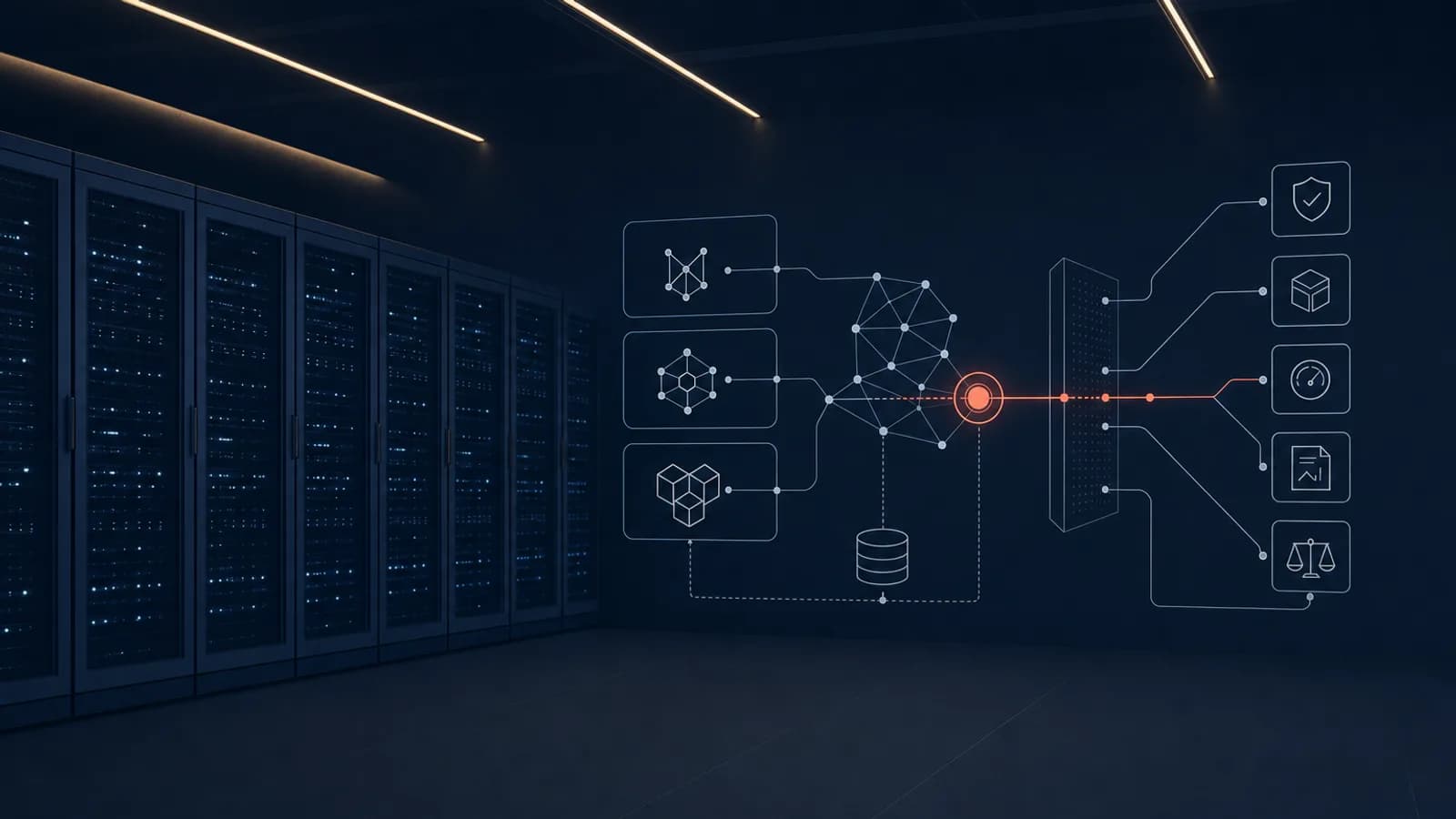
MNOs increasingly expose network capabilities to enterprises, platforms and MVNO partners, but an API gateway alone does not create a wholesale product. NEF exposure must connect partner identity, application authorisation, PCF policy, consent controls, usage records and dispute handling. The commercial question is therefore not whether a capability can be exposed, but which party owns the service commitment and how each invocation becomes billable, auditable and governable.
Start with the exposure boundary, not the API catalogue
The first architecture decision is not endpoint naming or gateway selection. It is the exposure boundary: which network functions the operator will make available, which partner classes may invoke them, and which service conditions apply. SCEF-mediated exposure should remain distinct from NEF mediation internally because their control paths, charging records and failure modes differ. The partner proposition, however, should not require a customer to interpret the split between an EPC service and a 5G service-based architecture.
A workable catalogue classifies operations into information retrieval, event subscription, policy influence and service exposure. A reachability query reads network-derived state. An event subscription creates persistent monitoring and callback obligations. A traffic-influence request seeks a bounded network action. These classes consume different control-plane resources, create different privacy exposure, and require different latency and charging rules. Treating them as equivalent API calls produces weak pricing and ambiguous service commitments.
Each operation should map to an authoritative function and control plane. Identity-related data may resolve against the HSS or UDM. Policy decisions remain with the PCF. Reachability context may originate from the AMF. Charging functions provide usage correlation. The mapping must also state whether the exposed operation initiates a network action or returns information. That distinction drives authorisation depth, rollback requirements and liability.
- SCEF scope
- 3GPP service exposure for EPC and selected 4G control-plane capabilities
- NEF scope
- 5G SBA exposure, event exposure, AF interaction and policy-related capability mediation
- Partner-facing contract unit
- Named API product with entitlement, SLA class, usage meter and jurisdictional scope
- Authoritative policy owner
- MNO PCF or PCRF domain; partners submit bounded requests rather than direct policy changes
API management remains a control point, not the wholesale product. OAuth client registration, throttling and portal documentation can govern access, but they do not determine subscriber entitlement, policy precedence or settlement accountability. A capability matrix should therefore record geographic availability, access-technology dependency, response target, consent requirement and fallback behaviour for every operation.
A Tier-2 MNO, Southeast Asia, ~18M subscribers used this boundary-first approach to separate gateway readiness from commercial launch readiness. Several endpoints were technically reachable before policy ownership and roaming fallback had been agreed. Keeping those endpoints outside the saleable catalogue prevented an integration milestone from being mistaken for a supportable service.
Translate partner intent into bounded PCF and PCRF actions
A partner should not receive unrestricted control over QoS, routing or subscriber state. Each enterprise or MVNO use case should resolve to a pre-approved policy template. The template fixes the DNN or APN scope, QoS profile, duration ceiling, geographic applicability and maximum concurrent sessions. Commercial entitlements then select among templates rather than modifying policy primitives directly.
In 5G, the NEF mediates between the application function, or AF, and the PCF. The partner can request an outcome, but the operator retains the final policy decision. For SCEF-era products, the equivalent dependencies on the PCRF, OCS and EPC must be documented. A common commercial name can mask the core-generation split, but it cannot erase differences in enforcement timing, session visibility or charging granularity.
Precedence must be deterministic. An API-initiated request may conflict with an existing retail policy, enterprise APN, roaming restriction or MVNO rule. The decision chain should specify which policy wins, whether the requested parameters may be modified, and which response is returned. Capacity protection and regulatory controls should always override a partner request, even where the partner has unused commercial entitlement.
The transaction record should preserve request, acceptance, modification and release events under one correlation identifier. That identifier must survive mediation across the API platform, NEF or SCEF, PCF or PCRF, and charging domain. Rejection responses should use contractually defined reason families: entitlement failure, capacity limit, subscriber state, roaming constraint and policy conflict. Internal cause codes can remain more granular, but the external taxonomy must be stable enough for automation and dispute analysis.
Make consent and data governance part of the service design
Location, reachability and event exposure cannot share one generic data-processing position. Controller and processor roles should be assigned by API product, data field, jurisdiction and partner type. The operator also needs to identify who obtains consent, who stores the evidence, which transaction checks it, and which party responds when the subscriber or enterprise principal revokes authority.
Consent evidence may need to bind to an IMSI, MSISDN or enterprise identity. The binding should persist only as long as required to validate access, fulfil the request and support a defined dispute window. Indefinite retention increases exposure without improving service delivery. Where identifiers rotate or a multi-IMSI implementation changes the serving identity, the audit chain must preserve the entitlement relationship without creating uncontrolled identity replication.
Data minimisation belongs at the response layer. A fraud workflow may need a reachability state or location confidence band, not precise coordinates. An event product may need to confirm a state transition without returning wider subscriber context. Reducing the response payload narrows the compliance surface and gives the operator a clearer basis for validating downstream use.
Roaming requires jurisdiction-specific handling. The home MNO may expose an event while the visited network controls the underlying RAN and remains subject to local obligations. The service design should state when the home operator can return a result, when precision is reduced, and when the request must be rejected. A generic global entitlement is not sufficient evidence that each visited-market data path is permissible.
An MVNE or MVNO also needs a different governance model from an enterprise application provider. Delegated subscriber-service responsibilities may justify access to defined network-derived data, but they do not confer authority over every event or identifier. An MVNE servicing 12+ tenants in EMEA addressed this by maintaining tenant-specific consent scopes, retention schedules and revocation paths rather than inheriting one host-level permission set.
Revocation must stop future notifications and remain traceable. Operations teams should be able to identify the partner client, callback destination, consent reference and historical responses associated with an event subscription. Without that retrieval path, the operator cannot show when processing ceased or determine which downstream system received data before revocation.
Choose charging units that match network cost and partner value
A single per-call tariff is rarely defensible across network exposure services. A device-status query, a high-frequency event subscription and an admitted QoS request consume different resources. Their value to the partner also differs. Pricing should combine a predictable commitment with a meter linked to the scarce resource, operational obligation or commercial outcome.
Recurring access fees are appropriate where the operator funds security review, onboarding, assurance coverage, dedicated tenancy or reserved policy capacity. Variable charging should then follow the service behaviour. Event products may be metered by successful delivery, active subscription interval or monitored device population. Contracts must specify how retries, duplicate notifications, callback failures and delayed delivery affect the billable count.
Policy-related products may be charged by admitted session, duration, traffic volume or defined QoS window. The choice depends on where the constraint sits. A control-plane admission limit favours session charging. Reserved radio or data-path treatment may favour time or volume measures. The operator should avoid charging for the requested outcome where the network record shows rejection, supersession or release before enforcement.
- Device status or reachability
- Per successful query or committed monthly device bundle
- Event exposure
- Per active subscription-day or successful event delivery, subject to deduplication rules
- QoS or traffic influence
- Per admitted session, QoS window or reserved policy entitlement
- Dedicated enterprise or MVNO tenancy
- Monthly platform and operational commitment plus measured overage
Before invoicing, API usage records should reconcile with the OCS, CHF or BSS record that confirms the network outcome. This is material when a request is accepted at the exposure layer but later revoked, modified or not enforced because subscriber state changed. The settlement model should define which record is authoritative and how timing differences are closed.
Service credits should attach to measurable exposure and mediation commitments: authentication availability, request acknowledgement, policy-decision response, event-delivery latency and record completeness. They should not extend to broad application-performance claims that depend on partner software, public-cloud routing or radio conditions. A Greenfield MVNO, post-2023, multi-IMSI stack used separate meters for event delivery and admitted policy windows because one represented monitoring volume while the other represented constrained network treatment.
Assign operational ownership across the partner chain
Commercial traffic should not begin until ownership is explicit across the MNO network domain, wholesale team, API platform operator, MVNE where present, and enterprise or MVNO partner. A RACI should cover onboarding, application credentials, policy-template approval, incident triage, settlement review and network change control. General statements about shared support are insufficient once an outage or invoice dispute crosses organisational boundaries.
The exposure platform owner should control credential lifecycle, client authentication and rate-limit enforcement. The MNO should retain PCF or PCRF approval and CN change control. If an MVNE provides the partner-facing interface, it may own first-line integration support and tenant administration, but it should not approve policy changes that alter host-network risk without an agreed delegation.
Incident handling should separate partner integration defects, gateway failures, NEF or SCEF mediation errors, policy-control failures, and RAN or core incidents. Each tier needs a clock start, evidence requirement and escalation path. A gateway HTTP response alone does not establish whether the underlying policy action completed. Conversely, a core alarm does not prove that a specific partner transaction failed.
Release governance should cover API versions, callback schemas, PCF template amendments and network upgrades that change response semantics, latency or charging records. Deprecation periods must reflect partner implementation cycles. Where backward compatibility cannot be maintained, the operator should define parallel-running rules and the date on which settlement moves to the new record format.
A monthly settlement review should reconcile gateway logs, mediation records, accepted policy actions and invoice lines before exceptions become aged receivables. The review should track unmatched identifiers, duplicate events, reversed admissions and records received outside the billing period. Commercial teams then resolve recurring defects at source rather than applying repeated invoice adjustments.
Structured operator engagement
Review the partnership model
Averon’s partnership programme addresses operating boundaries, accountability and settlement design for MVNO enablement engagements. It is structured around operator integration and wholesale governance rather than API aggregation.
NEF and SCEF monetisation will mature where operators package bounded capabilities with enforceable policy templates, evidence-grade metering and clear operational ownership. The durable opportunity is not raw API exposure; it is a wholesale product that can survive network changes, audit scrutiny and multi-party settlement.