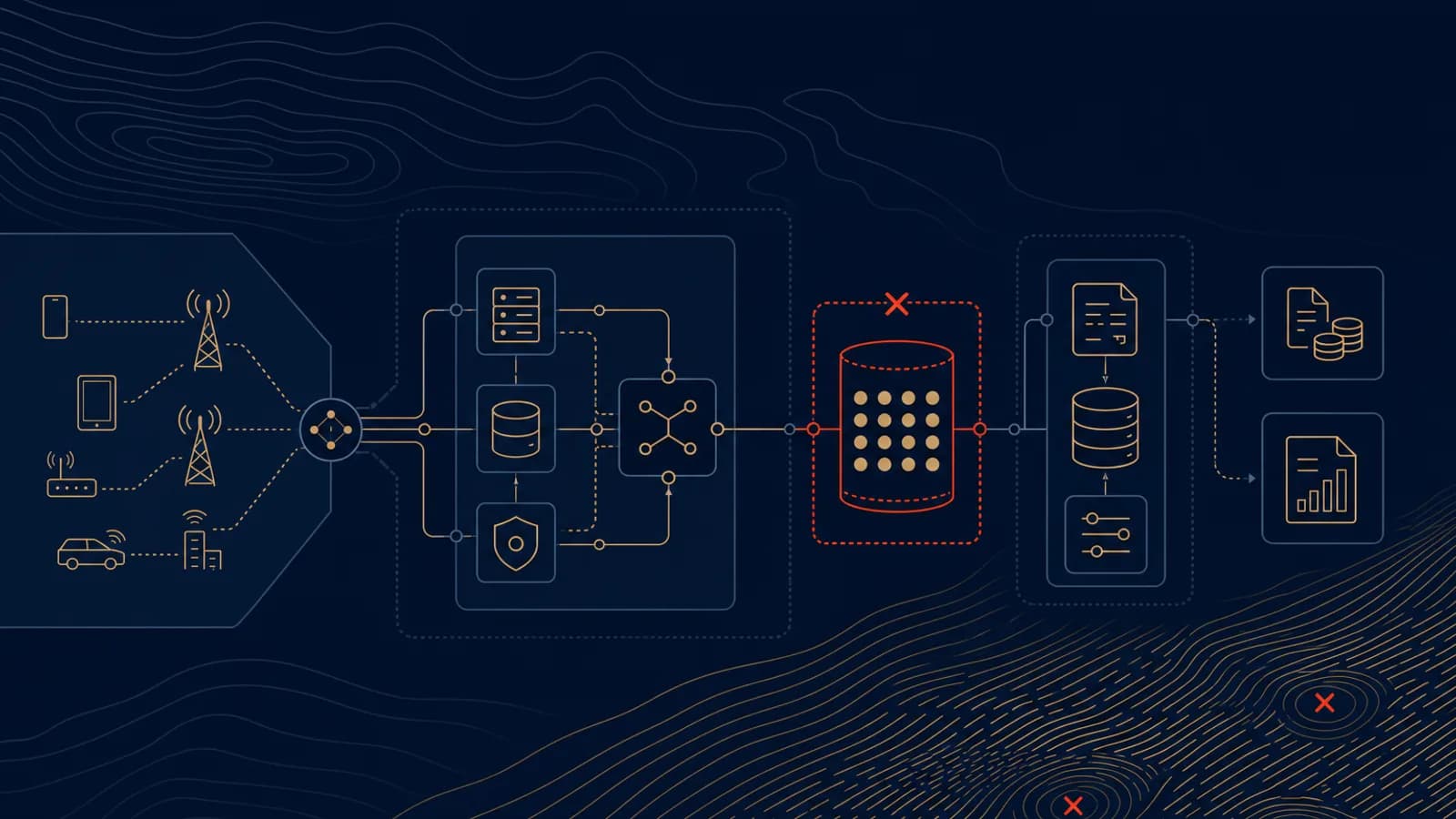
Sponsored data is often approved as a distribution or retention instrument before its control plane and settlement logic have been specified. That sequence creates avoidable subsidy exposure. A viable arrangement starts with a bounded sponsored-data rating group, then aligns OCS decisions, PCRF/PCF policy, BSS product configuration, and partner evidence around the same subscriber, application, time, and volume definitions.
Define the sponsored event before configuring policy
The commercial schedule must define an event precisely enough for policy, charging, mediation, and settlement to identify it without interpretation. Acquisition subsidy, service access, content distribution, enterprise-funded usage, and temporary campaign access are different products. They require different validity periods, ceilings, eligible populations, and settlement units. A campaign objective cannot substitute for a machine-enforceable eligibility rule.
The traffic definition should specify the relevant APN or DNN, IMSI range, MCC/MNC, IP address or FQDN set, SNI where visible, destination port, protocol, roaming state, and time window. Eligibility may attach to a named application, partner-controlled endpoint set, bearer, QoS flow, or service component exposed through policy control. The contract should identify which representation governs when those signals disagree.
Exclusions are equally material. Software updates, third-party CDN traffic outside the sponsor’s control, encrypted proxy sessions, detectable tethering, and generic internet fallback can create unbounded exposure. The parties must also set the commercial unit before launch: zero-rated MB, session, transaction, active day, capped bundle, or reimbursable threshold. An invoice cannot repair an undefined unit after traffic has been carried.
For a Tier-2 MNO, Southeast Asia, ~18M subscribers, the critical design question is not whether an application appears on a sponsored list. It is whether every delivery path used by that application remains inside a contractually controlled traffic population. Endpoint ownership and fallback behaviour therefore belong in the commercial schedule, not only in an engineering appendix.
Translate eligibility into OCS and PCRF/PCF control points
Policy should grant sponsored treatment only after charging has reserved a defined allowance. In an EPC deployment, the sponsored service identifier maps into the PCRF rulebase. The PCEF then receives a distinct charging key or rating group for the qualifying flow. Rule installation, quota reservation, usage reporting, and rule removal must refer to the same identifiers.
An SA 5G implementation requires a fresh control map rather than a literal migration of PCRF-era semantics. The design should state how PCF policy, CHF quota control, NEF exposure, and application-function inputs interact. It should also define the failure response when an application signal is absent, stale, or inconsistent with the network classifier. The safe default is normally paid treatment or service denial, not indefinite sponsorship.
Where the sponsor has a hard financial ceiling, OCS reservation creates an enforceable spend boundary at establishment and interim update. Rule precedence must cover subscribers who also hold a retail bundle: sponsored traffic may consume the partner allowance first, remain zero-rated to the subscriber until sponsor exhaustion, or revert to the retail balance. Interim reporting cadence should limit overshoot for video, FWA, and large file transfers. Cadence is therefore a credit-control parameter, not merely a network setting.
Make the rating model auditable across charging domains
Auditability depends on an identifier chain. A unique sponsor ID, campaign ID, rating group, charging key, and tariff version should survive policy decision, quota reservation, CDR generation, mediation, BSS posting, and invoice output. Versioning matters when endpoint lists, exclusions, caps, or prices change during an active campaign. Effective dates must prevent the same session from being interpreted under two rule sets.
The OCS balance bucket is a control object, not automatically the settlement record. The contract must state whether payment follows granted units, consumed units, successfully rated units, or reconciled network usage. Operators should retain the original usage record and the post-mediation record whenever normalization, deduplication, enrichment, or late arrival changes the result. This allows aggregate reconciliation and exception-level reconstruction from the same evidence base.
- Sponsor identifier
- Immutable ID carried from commercial order through policy rules, OCS bucket mapping, mediation, and invoice line items.
- Rating-group version
- Versioned policy and tariff reference used when endpoint lists, exclusions, or subsidy caps change during a campaign.
- Settlement usage basis
- Consumed and successfully rated units after defined mediation controls, with rejected and late records reported separately.
- Cap enforcement point
- OCS reservation or CHF quota control for hard caps; BSS-only control applies only where sponsor exposure is explicitly uncapped.
- Exception tolerance
- Pre-agreed variance by traffic type and record latency, supported by a documented dispute and credit-note process.
Tolerance rules should cover session rounding, missed interim updates, CDR lateness, duplicate detection, clock drift, and classifier changes. Each exception class needs an owner and escalation route. In a multi-IMSI or roaming proposition, home-policy eligibility must be separated from visited-network evidence. The agreement should allocate differences arising when TAP, NRTRDE, or wholesale usage files arrive after campaign closure.
Control traffic classification drift and subsidy leakage
Most margin leakage originates in delivery changes rather than the published tariff. Destination IP lists are weak long-term application identities where a partner uses shared CDN ranges, anycast, cloud fronting, or frequently changing edge nodes. FQDN, SNI, URL, IP range, and application-function updates should enter a controlled change process with effective dates, test evidence, rollback ownership, and notice periods.
Sponsored volume should be compared with a non-sponsored baseline by subscriber cohort, access type, geography, device class, APN or DNN, and time of day. A sudden shift in average session size, protocol mix, or geographic concentration can reveal classification expansion before invoice close. Monitoring should distinguish legitimate campaign uptake from traffic that has moved into the sponsored population because an endpoint, routing path, or encryption behaviour changed.
Edge testing should cover DNS failure, IPv6 and IPv4 divergence, QUIC classification, captive portal access, application fallback to third-party content, and policy-server timeout behaviour. Per-subscriber, per-IMSI, per-day, and campaign-level ceilings provide separate controls. An aggregate cap alone may still permit concentrated abuse, tethering, or reseller-driven consumption before the campaign limit is reached.
Build settlement governance into the partner operating model
Traffic should open only after a launch-readiness gate confirms policy-rule validation, OCS or CHF balance tests, CDR continuity, mediation mapping, BSS invoice rendering, reporting access, and partner acceptance of the traffic definition. Daily reporting should track cap consumption and classification exceptions. Material campaigns warrant weekly reconciliation, followed by monthly settlement with locked cut-off dates and explicit treatment of late records.
The evidence hierarchy must also be contractual. Network usage records, OCS or CHF event records, mediation output, BSS-rated records, and partner application logs serve different purposes and should not be treated as interchangeable. Liability should be allocated separately for incorrect policy configuration, inaccurate endpoint declarations, charging-platform outage, and delayed or defective records supplied by an external network. Each failure class needs rules for traffic treatment, sponsor exposure, subscriber charging, and adjustment notes.
For MVNO and MVNE structures, the settlement chain must identify whether the host MNO invoices the sponsor, invoices the MVNO, or settles through the MVNE. The same chain should govern VAT, credit risk, bad debt, and credit notes. An MVNE servicing 12+ tenants in EMEA also needs tenant-specific rating groups and invoice evidence; a shared sponsor construct should not obscure which tenant consumed the subsidy or which entity carries the receivable.
Operator partnership
Structure the operating model
Averon structures coordinated MVNO enablement, policy integration, and settlement design across host, MVNE, and tenant operating teams.
Sponsored-data programmes should be treated as controlled wholesale products, not as marketing exceptions applied to retail tariffs. As 5G policy and charging architectures mature, operators that preserve a common identifier chain from PCF decision to settlement invoice can contain subsidy exposure while retaining flexibility for new sponsor models.