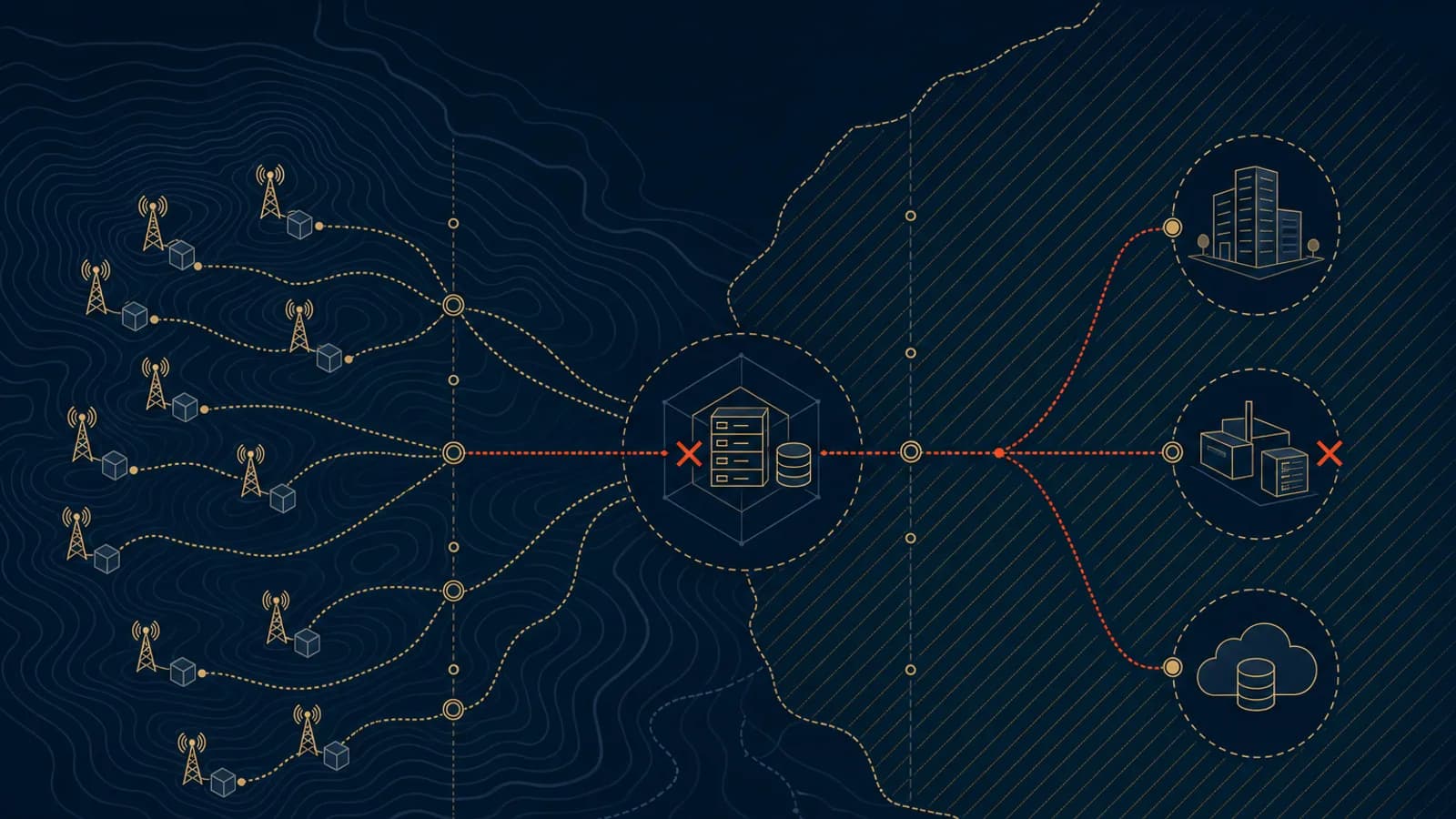
Multi-access edge computing has moved beyond the question of whether an MNO can host compute near the RAN. The harder question is whether a workload’s latency, data-residency, and traffic profile justify a distinct commercial construct. Local breakout sits at the centre of that construct: it determines where packets exit the mobile core, which party can measure consumption, and whether the operator retains an identifiable wholesale margin.
Start with the workload, not the edge footprint
MEC qualification should begin with the application’s required network path and operating model. Low latency alone is not a revenue case. Industrial vision, closed-loop control and selected public-safety workloads can justify a local UPF because delayed inference or control affects production, safety or process integrity. Many enterprise applications merely benefit from a lower round-trip time. If they remain functional through a central cloud region, the customer may not pay enough to support distributed infrastructure.
The operator should map the packet path before pricing the service. That path runs from the UE through radio access, transport, the serving UPF, the edge zone and the destination application. Traffic terminated inside an operator-controlled zone creates different assurance and settlement rights from traffic handed to a cloud partner or delivered through a private connection to an enterprise site. The placement of the operational demarcation determines which party can observe faults, enforce policy and certify usage.
Control requirements narrow the addressable market
Applications requiring 5G SA capabilities need further qualification. Network slicing, QoS flows, exposure through the NEF or a dedicated DNN can support a premium operating model because the operator can apply differentiated admission and policy. NSA deployments can serve selected edge use cases, but often lack the control granularity needed for a contractual SLA. A shorter physical path does not compensate for weak session control or an undefined fallback route.
Data residency should also be treated as a workload constraint, not a generic justification for city-level infrastructure. In-country processing may be satisfied by a central cloud region. Campus-level placement is justified only where regulation, operational continuity or application behaviour requires it. The operator should therefore define a minimum addressable site count before committing capital. Qualified demand per zone must absorb power, transport, hardware refresh, orchestration, security operations and field support.
- Industrial automation
- Requires local UPF and tightly bounded latency only where control loops, machine vision or safety processes are demonstrably sensitive to network delay.
- Enterprise data processing
- Usually prioritises residency, private connectivity and predictable egress charges over sub-20 ms latency.
- Cloud gaming and XR
- Can benefit from regional edge placement, but demand aggregation, device compatibility and content rights often determine commercial viability.
- Content delivery
- Primarily requires cache placement and transit reduction; it rarely supports a separate latency premium without a broader CDN or content agreement.
Make traffic steering and measurement contractual primitives
MEC monetisation weakens when traffic steering, metering and charging events are designed after the commercial agreement. Eligible sessions may reach an edge zone through DNN selection, DNS steering, application-aware routing, S-NSSAI policy or an enterprise APN. These methods differ in portability, policy enforcement, mobility behaviour and fault isolation. The contract should identify the control mechanism, its owner and the conditions under which traffic can leave the intended path.
The parties must then designate the authoritative usage record. An MNO may meter sessions at the UPF, within the PCF or OCS domain, at the IP transport layer or at an enterprise gateway. A cloud partner will normally record compute, storage and egress independently. Settlement becomes unstable if the network counts an active session while the platform counts only completed application transactions.
Radio consumption, transport, local breakout, compute, storage and cloud egress should remain distinct chargeable components in the cost model. Procurement may prefer a bundled unit price, but revenue assurance still requires auditable underlying units. Each record should connect an IMSI or enterprise subscriber group to a named tenant, edge zone, serving UPF and workload policy. Stable service identifiers allow fault correlation and preserve settlement continuity when sessions migrate between UPF locations.
Measure at the commercial demarcation
Latency, jitter, packet loss, availability and restoration time require named measurement points. An application SLA cannot be assigned wholly to the MNO when operator visibility ends at the N6 boundary. Measurement policy should state probe location, timestamp source, sampling interval, aggregation method and exclusions. The same discipline applies to usage disputes: parties need aligned clocks, agreed CDR retention, version-controlled record formats and rules for retransmitted, failed or partially completed sessions.
- Eligibility control
- DNN, S-NSSAI, enterprise APN or application policy identifier tied to the intended MEC service.
- Traffic demarcation
- Named UPF/N6 boundary, with documented routing policy and failover route to regional cloud or central breakout.
- Network usage record
- Session duration, UL/DL volume, QoS flow attributes, serving UPF, edge-zone identifier and timestamp basis.
- Compute usage record
- vCPU or accelerator time, memory allocation, storage, east-west traffic and cloud egress measured by the platform owner.
Allocate revenue ownership by controllable service layer
A single percentage split across an indistinct edge bundle obscures both cost and liability. The MNO should retain charges associated with mobile access, QoS treatment, private connectivity and operator-controlled breakout. These layers depend on spectrum assets, RAN policy, CN configuration and enterprise service assurance. The operator can price and warrant them because it controls admission, policy and restoration.
A cloud partner should normally own compute consumption, managed Kubernetes, software marketplace charges and platform-native services. The agreement can still allocate a commercial contribution for edge-zone capacity, cross-connects and reserved infrastructure. That contribution should be based on measurable commitments rather than attributed application revenue, which is difficult for the network party to verify and may vary for reasons unrelated to service performance.
Content workloads require a separate decomposition. Cache-hosting fees, avoided transit value, CDN delivery revenue and retail or advertising income have different economic owners. Combining them into a generic content share can transfer risk to an entity that cannot control demand, rights costs or advertising yield. Suitable settlement units include committed zone capacity, per-site fees, per-device connectivity, reserved QoS flows, throughput tiers, compute-hours and measured egress.
Under-utilisation risk must be explicit. A minimum capacity commitment can suit a cloud partner seeking predictable regional availability. An MNO should not fund expansion against non-binding pipeline forecasts. A phased structure is more defensible: paid design and integration, a limited production commitment, then additional zones after agreed utilisation, revenue and service-quality thresholds are met.
For a Tier-2 MNO, Southeast Asia, ~18M subscribers, subscriber scale alone does not support a distributed MEC case. The commercial gate should use traffic locality and qualified enterprise demand by zone. A large national base may still produce insufficient usage around individual edge sites, while a smaller concentration of industrial campuses can support committed capacity. The relevant denominator is contracted workload density, not total mobile connections.
Choose the partnership structure that matches operational control
For enterprise private networks, the MNO can act as prime contractor when it controls the mobile service, SIM lifecycle, QoS policy, field assurance and service-management interface. Cloud and systems-integration partners can then supply defined compute and application layers. Liability should follow those boundaries: the operator warrants connectivity and network policy, while the application party warrants workload availability and application performance.
Public cloud edge zones call for a wholesale capacity and interconnection construct. Commitments should cover space, power, transport, UPF placement, cross-connect diversity, incident coordination and planned-maintenance windows. The cloud partner should not be assumed to carry enterprise access obligations unless it has expressly accepted them. Conversely, the MNO should not warrant platform services that sit beyond its observability and change-control authority.
Content and CDN workloads are usually better served by host-and-deliver terms. The agreement should define cache-fill routes, backhaul responsibility, overflow treatment, reporting intervals and performance remedies. Economics may come from committed hosting capacity and retained transit savings rather than an end-user service charge. The parties should also state who pays when cache misses or regional failover send traffic back to a central origin.
Expansion requires a joint operating model spanning RAN, transport, EPC or 5GC, security patching, observability and incident management. Change control should identify approval rights, maintenance notice periods, severity definitions and escalation paths. After the first production sites, a commercial gate should compare forecast and actual traffic locality, compute utilisation, SLA events, enterprise churn exposure and the full cost of maintaining each zone.
Cross-border enterprise services add identity and settlement constraints. The topology must account for MNC/MCC identity, Roaming policy, local processing restrictions and intercompany charging. A technically local application path may still create cross-border control-plane, support or billing records. Those flows need review before the parties represent the service as locally contained.
MEC becomes commercially credible when the MNO can tie a qualified workload to a controlled traffic path, an auditable usage record and a clear owner for each service layer. Edge-site density is secondary to those controls. The next phase of deployment will favour partnerships that add capacity only after admission, assurance and settlement prove repeatable across sites and enterprise tenants.