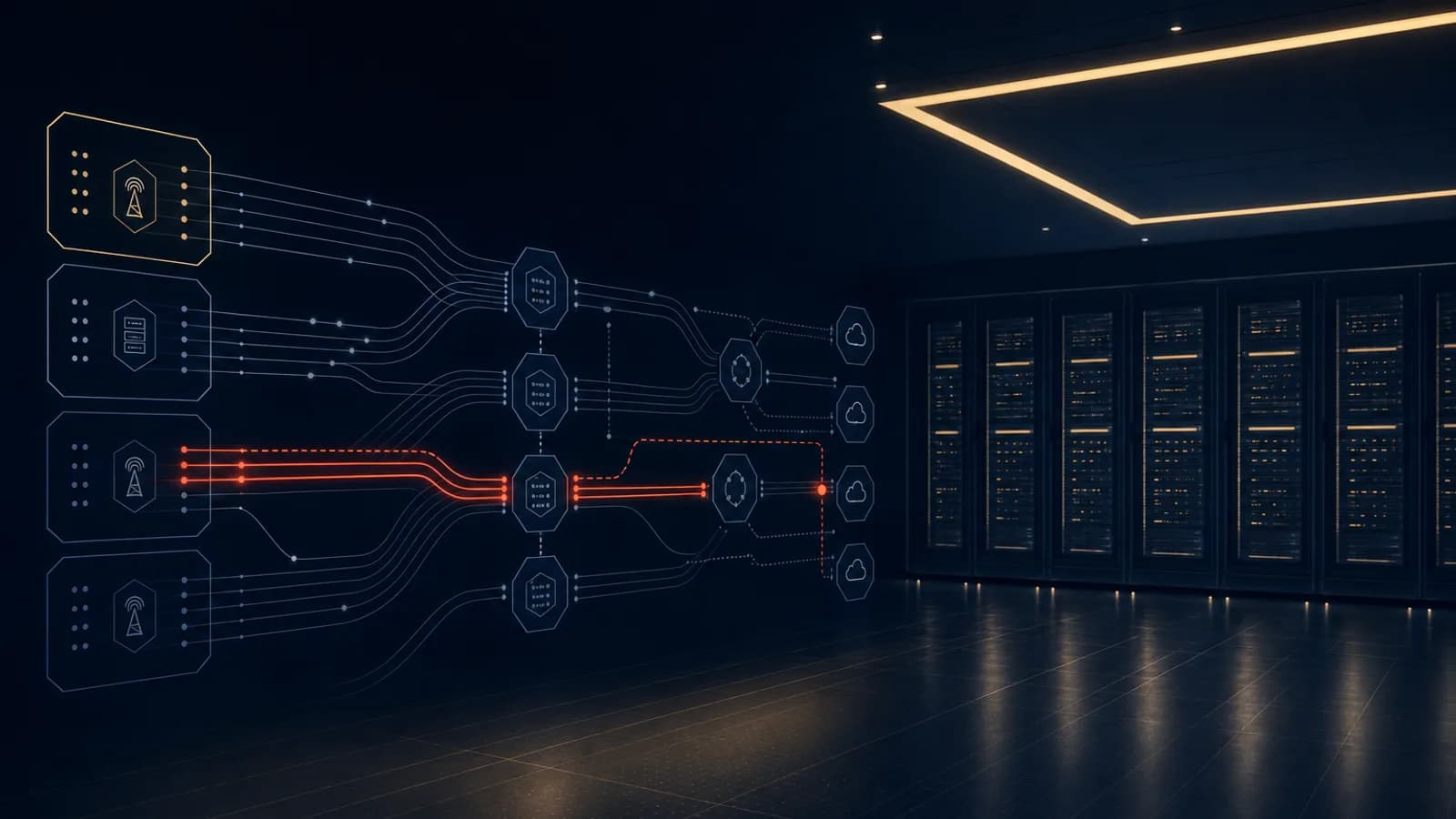
For MNOs and MVNEs, GTP-U tunnel efficiency is not a narrow packet-core tuning exercise. It is a commercial operating discipline that connects bearer design, UPF placement, tenant segmentation, roaming exposure and transport settlement. As multi-tenant MVNO portfolios diversify, aggregate throughput can remain stable while tunnel counts, signalling events and backhaul commitments rise materially. The relevant question is not whether capacity is available, but whether each traffic class consumes it under an accountable design.
Aggregate utilisation conceals the real transport problem
Average link utilisation describes how much capacity crossed an interface. It does not explain the work required to carry it. A low average can coexist with high cost when GTP-U tunnels are short-lived, unevenly distributed or repeatedly recreated across PGW, SGW and UPF domains. Each transition can add signalling, state management, route programming and troubleshooting exposure without producing a corresponding increase in billable traffic.
Tenant profiles therefore need to be compared by concurrency, session persistence and application mix, not only by carried volume. A low-ARPU IoT tenant may generate small payloads through persistent or frequently re-established sessions. A video-led digital MVNO may carry far more data through longer-lived flows. The first profile can consume disproportionate control-plane resources; the second can dominate busy-hour transport. Treating both as equivalent units of wholesale data obscures their different cost signatures.
The relevant operating view combines tunnel counts with bearer establishment rates, idle-to-active transitions, handover patterns, retransmissions and peak-hour geographic concentration. The experience of a Tier-2 MNO, Southeast Asia, ~18M subscribers illustrates the analytical gap: stable aggregate utilisation did not, by itself, distinguish routine subscriber growth from concentration caused by tenant routing and session behaviour. Without tenant and geography dimensions, transport counters could identify pressure but not assign its source.
This is why additional backhaul headroom is an incomplete answer. Capacity expansion may defer congestion while leaving inefficient bearer timers, anchoring choices and routing policies untouched. The planning unit must move from aggregate traffic carried to a model that identifies which tenant, access pattern and routing policy create marginal transport and CN cost. Headroom remains necessary for resilience, but it should not become a substitute for explaining why tunnel demand is rising.
Multi-tenant design turns transport policy into a margin question
A shared APN and broadly shared policy domain can shorten early tenant onboarding. It also weakens attribution when traffic patterns diverge. If several MVNOs use the same breakout, address space and policy treatment, wholesale reporting may show total usage while concealing which tenant drives session intensity, route asymmetry or concentrated busy-hour demand. The architecture has simplified activation at the cost of a more difficult margin analysis.
The alternative is not automatic isolation. Separate APNs, DNNs, IP pools and policy rules should follow traffic, regulatory or settlement requirements. Creating dedicated constructs for every commercial preference produces configuration sprawl and increases change risk. Sharing should remain the default where behaviour is comparable; separation should be introduced where it protects performance, cost attribution or contractual control.
Multi-IMSI models complicate that decision. Home routing, visited-network behaviour and breakout location can shift traffic among domestic, roaming and interconnect domains without appearing clearly in retail usage reporting. A subscriber may look ordinary in the BSS view while generating a materially different transport path because the active IMSI, serving network or policy anchor has changed.
Traffic steering consequently needs an accountable owner across wholesale, packet core and IP transport teams. Without one, a commercial commitment can introduce an unpriced routing exception that persists long after launch. Chargeback should reflect sustained busy-hour demand, session intensity and geographic concentration, rather than relying only on subscriber count or wholesale data volume. Those measures are not substitutes for the commercial tariff; they are the evidence required to test whether the tariff still covers the network behaviour.
An MVNE servicing 12+ tenants in EMEA faces this trade-off directly. Full isolation across every tenant would create an expensive topology and a large operational surface. Indiscriminate sharing would make exceptions difficult to trace and price. Selective separation provides the more durable model: standard shared domains for comparable traffic, dedicated treatment where regulation, performance or settlement requires it, and explicit review when observed behaviour departs from the onboarding assumptions.
Tunnel control must be designed across signalling and user planes
Tunnel overhead cannot be reduced through separate control-plane and user-plane programmes. GTP-C policy determines when bearers are established, modified and released; GTP-U forwarding carries the resulting traffic. Aggressive release settings may reduce idle state but increase re-establishment activity. Long persistence may suppress signalling while retaining state and path commitments. The correct balance depends on tenant behaviour, mobility and failure-recovery requirements.
In EPC environments, coordination across the MME, SGW, PGW, PCRF and transport engineering determines whether peak-period behaviour remains predictable. A policy change that appears minor within one function can alter bearer frequency, gateway selection or path concentration elsewhere. Change approval should therefore test tunnel-scale effects, not only functional correctness or policy compliance.
The same economics persist in NSA 5G and SA 5G. SMF and UPF selection, N9 paths, local breakout and service continuity determine where traffic is anchored and how far it travels. Cloud-native deployment changes how functions are instantiated and scaled. It does not remove transport distance, encapsulation overhead or interconnect settlement from the cost base.
Distributed UPF placement should therefore follow evidenced latency demand, traffic locality and interconnect cost. Deploying more sites without a supported traffic case can multiply interfaces, observability requirements and failure domains. Capacity planning across S1-U, S5/S8, N3 and N9 must include tunnel scale, packet-size distribution, encapsulation overhead and failover behaviour, rather than extrapolating throughput alone.
Operators need a common dataset to govern these decisions. GTP telemetry should be correlated with IP/MPLS counters, policy events, gateway selection and tenant identifiers. Agreed thresholds should distinguish expected growth from anomalous churn, route concentration and repeated tunnel recreation. This is less an observability project than an operating agreement: packet core, transport and wholesale teams must use the same evidence when deciding whether to tune policy, add capacity or reprice an exception.
Efficiency requires commercial governance, not only packet-core engineering
The durable control point sits upstream of network operations. Wholesale product definitions should state the supported breakout model, APN or DNN options, expected traffic profiles, roaming assumptions and constraints on dedicated routing. These are not implementation footnotes. They establish the cost envelope against which a tenant proposition is priced and approved. Ambiguity at contract stage becomes an engineering exception after launch, when remediation is slower and commercial recourse is weaker.
Onboarding must test behaviour, not merely accept forecast spreadsheets. Busy-hour concurrency, session persistence, DNS patterns, breakout selection and failure recovery should be exercised before a tenant reaches material scale. The purpose is not to predict every application. It is to establish a baseline that reveals whether production behaviour changes the assumed tunnel and transport profile.
That baseline must remain reopenable. An MVNO that adds enterprise services, FWA or roaming-heavy segments can change concurrency, locality and anchoring requirements without a proportionate change in subscriber numbers. Wholesale governance should permit technical and commercial assumptions to be reviewed when the product mix changes. Otherwise, the host absorbs complexity that was neither modelled nor priced in the original agreement.
The counter-position is valid: excessive controls can slow sales, prolong onboarding and create needless engineering friction. The answer is not unrestricted exceptions. It is a standard catalogue with defined breakout, policy and isolation options, supported by priced deviation paths. This preserves commercial speed for conventional deployments while making bespoke routing or dedicated domains visible to the decision-makers who own margin and operational risk.
Periodic joint reviews between the MVNE, MNO packet-core and transport teams should determine whether rising cost reflects genuine growth, policy misconfiguration, inefficient routing or a mismatch between contracted and observed behaviour. GTP efficiency is useful only when it informs margin protection and service assurance; it should not become a standalone KPI or a rationale for blanket traffic restriction. As MVNO portfolios become more heterogeneous, operators that connect GTP telemetry to routing policy and wholesale economics will be better placed to scale traffic without allowing unpriced complexity to accumulate in the mobile core.