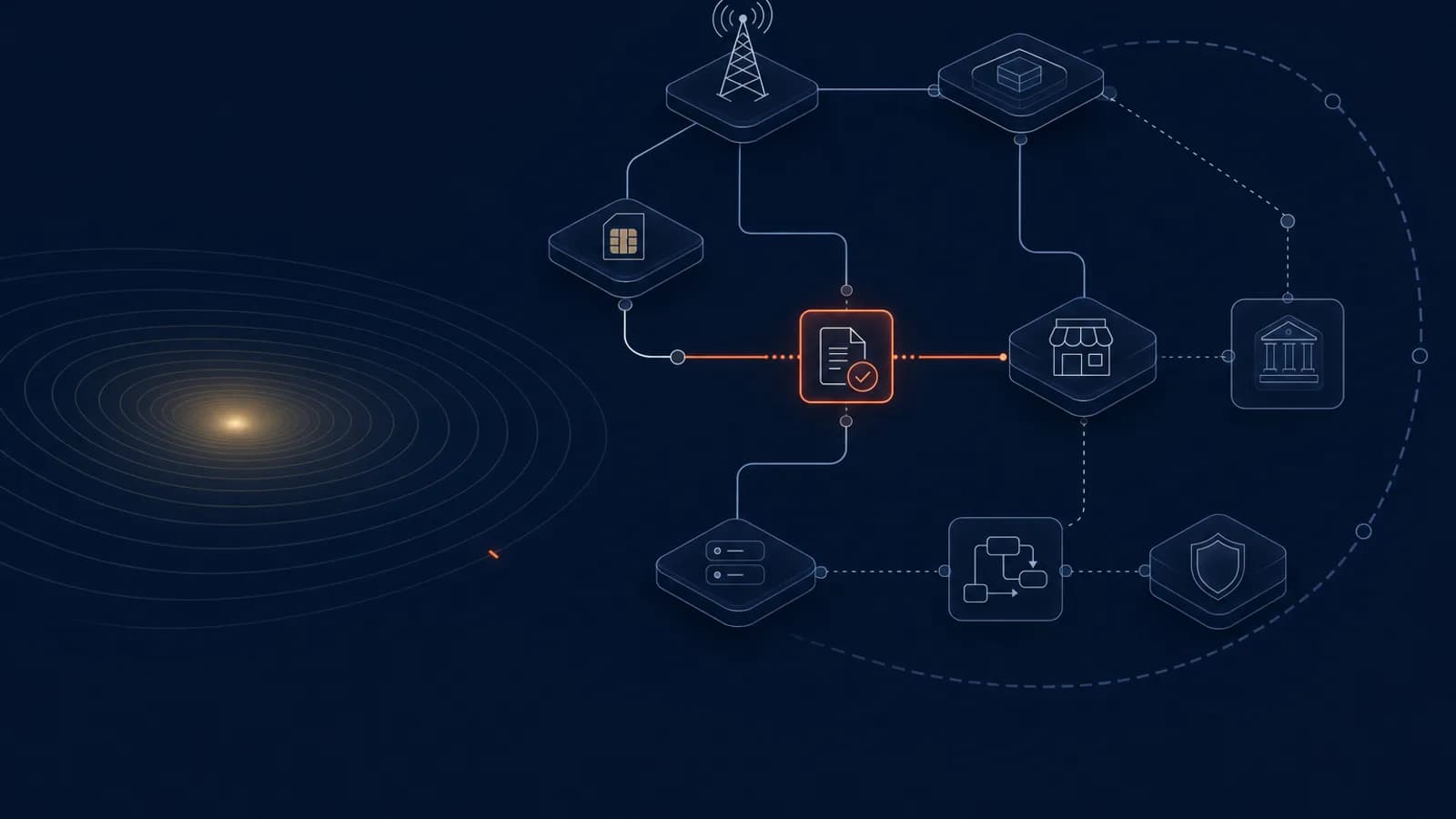
European Direct Carrier Billing partnerships now face a tighter control environment than their historic digital-content focus suggests. The decisive asset is no longer only the billing connection to the operator’s OCS, but the integrity of DCB consent records across the merchant, payment intermediary, MVNE, and MNO. Where those records are incomplete, complaints can become refunds, regulatory inquiries, merchant losses, and wholesale-partner friction with unusual speed.
The compliance perimeter is widening beyond the payment flow
European DCB exposure no longer sits within a single telecom compliance lane. It arises from the interaction of payments law, consumer protection, privacy governance, national enforcement, and the operator’s contractual control over merchants and intermediaries. A transaction can remain technically valid at the charging interface while failing elsewhere because the product was ineligible, the renewal disclosure was unclear, the consent record was weak, or the refund route was inaccessible.
PSD2 retains an electronic-communications exemption for qualifying digital content, voice-based services, charitable activity, and certain ticketing use cases. That exemption remains commercially important, but it is not a blanket exclusion for operator billing. Product scope, transaction structure, reporting obligations, and national implementation require active legal and operational review. Reliance on inherited contract wording is particularly fragile when a merchant changes its offer, introduces a subscription, or adds sub-merchants without renewed approval.
The €50 per-transaction and €300 monthly limits commonly associated with the exemption are control parameters, not a complete risk framework. Operators must also test product eligibility, subscriber status, cumulative spend logic, and whether linked transactions are being fragmented to remain below a threshold. Controls should operate before charge submission and again during settlement review. A technically successful debit does not establish that the underlying service qualified for the exemption.
Consumer-law expectations add a separate evidential burden. Pricing must be prominent, the subscriber must take an affirmative action before billing, recurring terms must be disclosed before enrolment, and cancellation and refund routes must be usable. These requirements determine what the operator and its partners need to retain. A screenshot of a generic campaign page is weaker than a timestamped record of the precise market, language, price, merchant identity, renewal terms, and action shown during the disputed transaction.
GDPR creates another governance layer around consent-event data, device identifiers, MSISDN handling, retention periods, access controls, and controller-processor allocation. Payment evidence should be retained long enough to support disputes and audits, but not indefinitely by default. Contracts must align the legal role of each party with its actual ability to collect, alter, retrieve, and delete the data.
The commercial consequence is structural. Wholesale teams are moving DCB from a low-touch value-added-services arrangement toward a governed, payments-adjacent product line. Merchant admission criteria, change controls, audit rights, reserve policies, and evidence-production obligations increasingly sit alongside routing and revenue-share terms. A Tier-2 MNO, Western Europe, ~18M subscribers would therefore assess a new merchant not only on projected conversion and gross billings, but also on complaint history, fulfilment design, consent capture, and recourse capacity.
Consent evidence has become the first line of loss containment
A defensible transaction requires a reconstructable event trail connecting offer presentation, subscriber authentication, charge instruction, fulfilment, and post-sale support. The record should preserve the exact price, merchant identity, product description, recurring-billing terms where applicable, timestamp, language or market variant, and affirmative action that initiated the charge. Evidence must identify the transaction under dispute rather than point to a campaign template that may have changed during its run.
Authentication design must distinguish device possession, network-based identification, SMS OTP, and delegated wallet confirmation. Each mechanism answers a different question. Network identification can associate traffic with an account, while an OTP can demonstrate access to a device or number at a specific time. Neither, by itself, proves that the subscriber saw and accepted a particular price, merchant, product, or renewal schedule.
Intermediaries should pass transaction-level evidence into a retrievable dispute workflow. Periodic aggregate reporting is insufficient once complaints have accumulated because it cannot establish which disclosure, identity check, or fulfilment event applied to an individual charge. Retrieval performance also matters. If customer care waits several days for a merchant to assemble records, the evidential system has failed operationally even if the documents eventually arrive.
- Offer evidence
- Price, merchant identity, product description, renewal terms, market variant, and affirmative action captured at the point of consent
- Network evidence
- Timestamped charging request, IMSI or account association where permitted, OCS outcome, and transaction reference
- Fulfilment evidence
- Delivery timestamp, entitlement activation, content-access record, or service-use confirmation
- Dispute evidence
- Complaint source, response clock, refund decision, reversal reference, and merchant recovery status
- Retention governance
- Documented retention schedule, access controls, deletion triggers, and audit retrieval process
Consent data should reconcile to OCS charging records, refund events, and merchant settlement files through a persistent transaction reference. Gaps between these systems are where duplicate charges, disputed renewals, and unfulfilled digital goods become expensive to resolve. A charge appearing in the OCS but absent from the merchant entitlement platform should not enter ordinary settlement without investigation. Equally, a merchant fulfilment record with no matching charge may indicate retry logic, reference corruption, or a timing defect.
MNP and number reassignment require explicit treatment. Historical association with an MSISDN does not show that the current account holder accepted a charge or inherited a subscription. Evidence models should therefore preserve time-bounded account association and, where permitted, IMSI or equivalent account context without treating either as consent. An MVNE servicing 12+ tenants in EMEA also needs tenant-level isolation, consistent reference formats, and retrieval controls that prevent one tenant’s dispute team from accessing another tenant’s records.
Merchant governance is replacing volume-led onboarding
Operators with lower dispute exposure treat merchant selection, product monitoring, and settlement protection as linked controls. Due diligence should test beneficial ownership, prior complaint history, product category, fulfilment method, refund policy, customer-support capacity, and the identity of every sub-merchant or traffic affiliate. Approval should attach to a defined product and acquisition flow. It should not operate as an indefinite credential allowing the merchant to add new services without review.
Higher-risk categories require different commercial treatment. Depending on product eligibility and observed behaviour, measures can include lower transaction caps, tighter campaign approval, enhanced monitoring, settlement reserves, shorter exposure windows, or exclusion. Faster settlement is not inherently lower risk: it may reduce the funds available for refunds and merchant recourse after a complaint spike. Finance, compliance, and wholesale teams need a shared view of the unsecured position by merchant.
Contracts must allocate operational responsibility with more precision than a generic indemnity provides. The critical clauses cover refund funding, regulatory cooperation, evidence-production deadlines, data-access rights, sub-merchant approval, settlement holds, and termination triggers. They should also state which party can suspend traffic immediately. An indemnity may support later recovery, but it does not answer an urgent subscriber complaint or stop a defective renewal campaign.
Monitoring should distinguish ordinary commercial variance from emerging control failure. A practical dashboard tracks:
complaints and refunds per 1,000 successful transactions, segmented by merchant, product, market, and acquisition source;
repeat MSISDN disputes, disputed renewals, and complaint concentration around specific campaign versions;
consent-evidence retrieval time, missing-record rates, and cases closed without merchant evidence;
refund ageing, merchant recovery status, reserve coverage, and exposure before the next settlement run;
unusual changes in conversion, retry rates, renewal patterns, fulfilment latency, or merchant concentration.
Settlement teams should separate subscriber goodwill refunds from suspected abuse, billing defects, fulfilment failure, and merchant insolvency. Collapsing these categories into one refund rate obscures the root cause and weakens recourse. A Greenfield MVNO, post-2023, multi-IMSI stack may face additional complexity where the retail relationship, charging route, and settlement counterparty sit in different jurisdictions. Its controls need to map each transaction to the responsible merchant, serving profile, account state, and contractual recovery path.
Refund operations will determine partnership durability
The speed and ownership of remediation increasingly determine whether a DCB complaint remains an operating cost or develops into a material wholesale and regulatory issue. Operators need a single dispute taxonomy across customer care, the intermediary, merchant operations, finance, and compliance. Each case should have named owners for acknowledgement, evidence retrieval, refund approval, merchant recourse, and closure. Without common categories, teams count the same failure differently and escalation thresholds lose meaning.
Refund pathways must accommodate active subscribers, disconnected accounts, barred accounts, and ported numbers. A credit to the mobile bill is not always possible or appropriate after account status changes. The operating model should define alternative payment routes, identity checks, approval limits, accounting treatment, and proof that the subscriber received the remedy. It should also prevent a merchant from treating operational difficulty as a reason to reject an otherwise valid refund.
Service levels should run from complaint receipt, not from the moment a merchant supplies evidence. Otherwise, the party controlling the records also controls the clock. Wholesale directors should set separate deadlines for acknowledgement, evidence retrieval, provisional protection, refund decision, execution, and merchant recovery. They should measure tail performance as well as averages because a small group of unresolved cases often generates repeat contacts, executive escalations, and external complaints.
Incident plans also need volume testing. A single merchant campaign producing 1,000+ complaints can exceed customer-care capacity before the commercial team recognises a pattern. The stress test should cover OCS reversal limits, settlement holds, evidence export, complaint deduplication, communications approval, merchant suspension, and regulator-ready reporting. It should identify who can stop charging outside normal governance hours and how already-instructed renewals will be blocked.
As European payment reform and national enforcement develop, partners that can evidence controls at transaction level will retain more commercial flexibility than those relying on merchant attestations and retrospective samples. Transaction caps and reserves can absorb some loss, but they cannot repair missing consent evidence or an inaccessible cancellation path. Strong remediation performance also changes negotiation dynamics: operators can distinguish isolated subscriber disputes from systemic merchant failure and allocate cost accordingly.
DCB remains a viable operator payment channel in Europe, but its risk-adjusted economics now depend on control architecture as much as distribution reach. The durable partnerships will price merchant risk explicitly, retain transaction-grade evidence, and treat refund execution as a core wholesale capability. Conversion remains relevant, but only after consent integrity, liability allocation, and remediation capacity are established.